
Jeremy A. Gibbs

Jeremy A. Gibbs

Physical Scientist

National Severe Storms Laboratory

Professional Summary

I am a Physical Scientist at the NOAA National Severe Storms Laboratory. My research includes computational and theoretical studies of atmospheric boundary-layer flows, turbulence modeling, land-surface modeling, parameterization of boundary-layer and surface-layer interactions, and multi-scale numerical weather prediction. I am currently working on projects to improve atmospheric models in the areas of scale-aware boundary-layer physics, heterogeneous boundary layers, and other storm-scale phenomena.

Education

Ph.D., Meteorology

2009-01-01
2012-12-31

Univ of Oklahoma

M.S., Meteorology

2006-08-01
2008-12-31

Univ of Oklahoma

B.S., Meteorology

2002-08-01
2006-07-31

Univ of Oklahoma

Interests

Multiscale NWP DNS, LES, RANS, WRF Boundary-layer flows SL/BL Parameterizations
Featured Publications

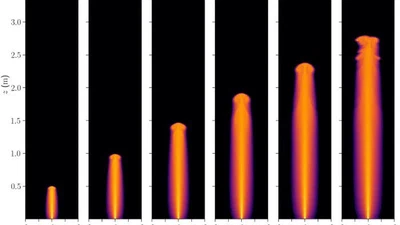
Revisiting the laminar plume

We revisit the classical problem of a laminar plume arising from a point source of heat on a horizontal boundary of infinite extent in an otherwise motionless neutrally stratified …
alan-shapiro

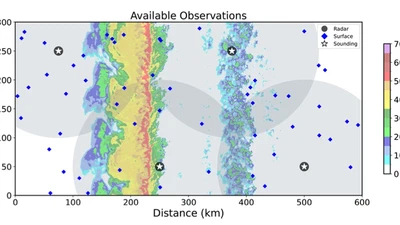
A method for generating a quasi-linear convective system suitable for observing system simulation experiments

To understand the impact of different assimilated observations on convection-allowing model forecast skill, a diverse range of observing system simulation experiment (OSSE) case …
john-d.-labriola

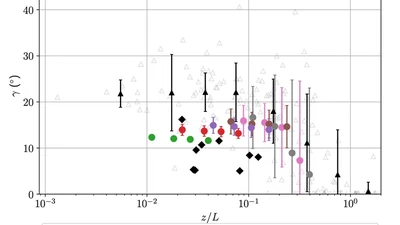
Inclination Angles of Turbulent Structures in Stably Stratified Boundary Layers

There is a rich history of studying coherent structures in the atmospheric boundary layer through the use of spatial correlations between wall shear stress and elevated velocity …

avatar
Jeremy A. Gibbs

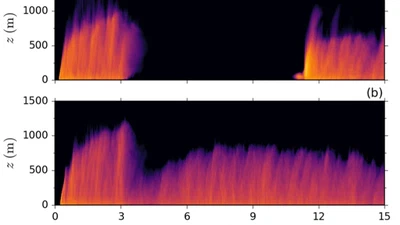
Numerical study of nocturnal low-level jets over gently sloping terrain

Nocturnal low level-jets (LLJs) over gently sloping terrain typical of the U.S. Great Plains are investigated by means of direct numerical simulation. Such LLJs develop in a tilted …

evgeni-fedorovich
Recent Publications
(2025). A Framework for Convective-Scale Observing System Simulation Experiments Using Ensembles. Wea. Forecasting, 40(10), 2147–2157.
(2025). Improving the Performance of a Reduced-Order Mass-Consistent Model for Urban Environments and Complex Terrain With a Higher-Order Geometrical Representation. J. Adv. Model. Earth Syst., 17(5), 1–39.
(2025). Revisiting the laminar plume. Phys. Fluids, 37(4), 1–13.
(2023). QES-Plume v1.0: a Lagrangian dispersion model. Geosci. Model Dev., 16(20), 5729–5754.
(2023). A method for generating a quasi-linear convective system suitable for observing system simulation experiments. Geosci. Model Dev., 16(6), 1779–1799.
Recent News

PyBurgers v2.0

Announcing PyBurgers v2.0 I’m excited to announce the release of PyBurgers v2.0. PyBurgers implements direct numerical simulation (DNS) and large-eddy simulation (LES) for studying …

avatar
Jeremy A. Gibbs