Revisiting the laminar plume
Apr 2, 2025·

Alan Shapiro
Equal contribution
Jeremy A. Gibbs
Equal contribution
·
0 min read
Abstract
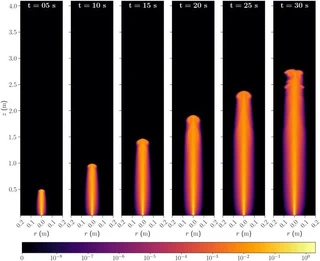
We revisit the classical problem of a laminar plume arising from a point source of heat on a horizontal boundary of infinite extent in an otherwise motionless neutrally stratified environment. The Boussinesq equations of motion and thermal energy for a steady axisymmetric plume are approximated separately for the plume interior and exterior, with the two regions connected via pressure continuity and use of the transverse (radial) equation of motion, an equation that has not been used in previous theoretical analyses of laminar plumes. An analysis of the governing equations yields a simple relation between the azimuthal vorticity and buoyancy, two variables of prime interest in studies of axisymmetric thermals, plumes, and jets. The relation states that when the Prandtl number is 1, the vorticity is equal to the buoyancy times radius divided by twice the kinematic viscosity. A more complex vorticity–buoyancy relation is obtained for arbitrary Prandtl numbers. The same vorticity–buoyancy relations are predicted for the plume interior and exterior. The relation for a Prandtl number of 1 is validated using output from a direct numerical simulation of a laminar plume induced by a small heat source on the lower boundary. The steady—state vorticity–buoyancy relation is confirmed in regions that have attained a steady state and also, remarkably, at earlier times, where the plume cap has passed, but the flow is still evolving.
Type
Publication
Physics of Fluids, 37(4), 1–13

Authors
Physical Scientist
I am a Physical Scientist at the NOAA National Severe Storms Laboratory. My research includes computational and theoretical studies of atmospheric boundary-layer flows, turbulence modeling, land-surface modeling, parameterization of boundary-layer and surface-layer interactions, and multi-scale numerical weather prediction. I am currently working on projects to improve atmospheric models in the areas of scale-aware boundary-layer physics, heterogeneous boundary layers, and other storm-scale phenomena.