Article-Journal

A Framework for Convective-Scale Observing System Simulation Experiments Using Ensembles

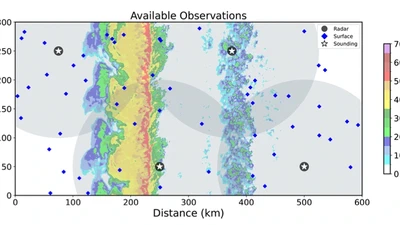
Convection-allowing models are used to predict the evolution of severe weather phenomena in the atmosphere. These models are sensitive to errors in the numerical environment used …

avatar
Jeremy A. Gibbs

Improving the Performance of a Reduced-Order Mass-Consistent Model for Urban Environments and Complex Terrain With a Higher-Order Geometrical Representation

Solid structures (buildings and topography) act as obstacles and significantly influence the wind flow. Because of their importance, faithfully representing the geometry of …

behnam-bozorgmehr

Revisiting the laminar plume

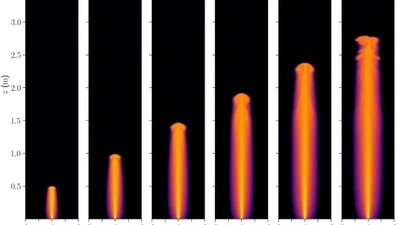
We revisit the classical problem of a laminar plume arising from a point source of heat on a horizontal boundary of infinite extent in an otherwise motionless neutrally stratified …

alan-shapiro

QES-Plume v1.0: a Lagrangian dispersion model

Low-cost simulations providing accurate predictions of transport of airborne material in urban areas, vegetative canopies, and complex terrain are demanding because of the …

fabien-margairaz

A method for generating a quasi-linear convective system suitable for observing system simulation experiments

To understand the impact of different assimilated observations on convection-allowing model forecast skill, a diverse range of observing system simulation experiment (OSSE) case …

john-d.-labriola

Inclination Angles of Turbulent Structures in Stably Stratified Boundary Layers

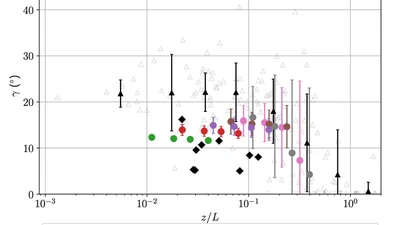
There is a rich history of studying coherent structures in the atmospheric boundary layer through the use of spatial correlations between wall shear stress and elevated velocity …

avatar
Jeremy A. Gibbs

QES-Fire: a dynamically coupled fast-response wildfire model

A microscale wildfire model, QES-Fire, that dynamically couples the fire front to microscale winds was developed using a simplified physics rate of spread (ROS) model, a kinematic …

matthew-j.-moody

Utilizing dynamic parallelism in CUDA to accelerate a 3D red-black successive over relaxation wind-field solver

QES-Winds is a fast-response wind modeling platform for simulating high-resolution mean wind fields for optimization and prediction. The code uses a variational analysis technique …

b.-bozorgmehr

Large-Eddy Simulation of the Atmospheric Boundary Layer

Over the last 50 years the large-eddy simulation (LES) technique has developed into one of the most prominent numerical tools used to study transport processes in the atmospheric …

rob-stoll

Structure functions and structure parameters of velocity fluctuations in numerically simulated atmospheric convective boundary layer flows

We extend our previous study, which dealt with structure functions of potential temperature fluctuations, and focus on the characteristics of second-order velocity structure …

avatar
Jeremy A. Gibbs